

AI Photo Calorie Tracking: How a Single Snap Replaces an Hour of Manual Logging
Tired of typing every meal into a food diary? AI photo calorie tracking lets you log a full meal in seconds by just taking a photo. Here's how it works, how accurate it really is, and why it's the fastest way to hit your goals.
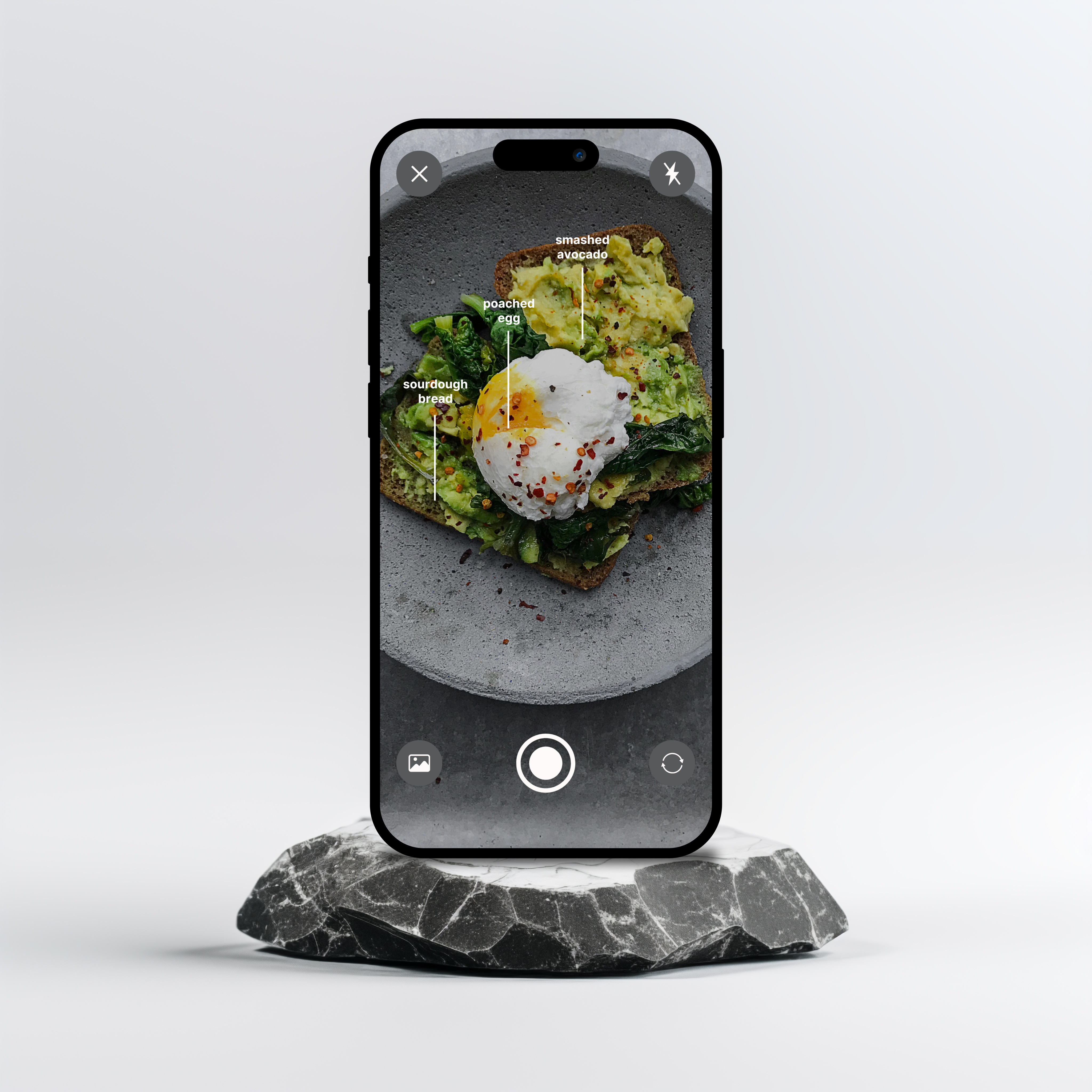
TL;DR: AI photo calorie tracking uses your phone's camera and machine learning to instantly identify food, estimate portion sizes, and log calories automatically. Modern AI achieves up to 92% accuracy on average, far better than the 30%+ underestimation typical of manual logging. If you've ever abandoned a food diary after a week, this approach removes the #1 reason people quit: friction. Snap a photo, get your macros, move on.
Most people don't fail at calorie tracking because they lack discipline. They fail because it's tedious. Looking up every ingredient, weighing portions, searching databases for "chicken breast, grilled, 150g" — it adds up fast. In a world where 90% of people abandon calorie tracking apps, the problem isn't motivation. It's the method.
AI photo calorie tracking flips that. You take a photo of your plate. The AI figures out what's on it. You get your calories and macros in seconds. No typing. No searching. No guessing.
This post breaks down exactly how it works, how accurate it is in 2025, and why it's quickly becoming the default way to track nutrition.
How Does AI Photo Calorie Tracking Actually Work?
AI photo calorie tracking uses computer vision and deep learning to identify food items in an image, estimate their portion sizes, and cross-reference a nutrition database to calculate calories and macros automatically.
Here's the process in plain terms:
- You snap a photo of your meal.
- The AI identifies every food item it sees (like "rice," "broccoli," "chicken").
- It estimates the portion size using depth estimation or reference objects in the frame.
- It pulls the nutritional data from a database and logs the totals.
The whole thing takes under 10 seconds. Compare that to 5-10 minutes of manual database searching per meal.
Modern systems use convolutional neural networks trained on millions of food images. Research from NYU Tandon showed that combining enhanced computer vision with improved nutrition prediction models increased calorie estimation accuracy by 25.5% compared to older approaches.
How Accurate Is AI Photo Calorie Tracking?
AI photo calorie tracking now averages 92% accuracy for common meals, with top systems hitting 97% for single food items. That's not perfect, but it's dramatically better than what most people manage on their own.
Here's what the research actually shows:
Manual logging typically underestimates calorie intake by 30% or more. People forget condiments, underestimate portion sizes, and skip snacks. AI doesn't do any of that. It estimates from what it sees, consistently.
A 2025 scoping review published in Frontiers in Nutrition looked at image-based dietary management tools and found they perform best with simple, well-lit meals. Mixed dishes and non-Western foods remain a challenge. But for most everyday meals, the accuracy is solid.
The bottom line: a consistent 92% is more useful than a theoretically perfect method you'll quit in two weeks.
Why Manual Logging Fails Most People
Manual food logging has one fatal flaw: it requires effort at the exact moment you're least likely to give it.
You just cooked dinner. You're hungry. You want to eat. The last thing you want to do is open an app and spend five minutes searching for each ingredient.
Studies show that 70% of users abandon dietary apps within two weeks if the logging process is too complex or time-consuming. The process becomes the problem.
AI photo tracking removes almost all of that friction. You already have your phone in your hand. One tap, one photo. Done. That's the difference between a habit that sticks and one that doesn't.
What AI Can and Can't Identify
AI tracking has come a long way, but it's not magic. Here's the honest breakdown:
Works well:
- Common restaurant meals and fast food
- Single-ingredient foods (chicken, rice, eggs, fruit)
- Standard portion sizes on a plate
- Packaged foods with visible branding
Still tricky:
- Mixed homemade dishes with complex ingredients
- Foods from non-Western cuisines (a 2024 study noted AI apps overestimated energy for Western diets by 1,040 kJ and underestimated for Asian diets by 1,520 kJ)
- Heavily layered meals (like a sandwich)
- Liquid calories (smoothies, soups)
The fix for tricky meals is simple: add a quick manual adjustment. Most AI apps let you do this in seconds.
The Adherence Advantage: Why Easier Tracking Means Better Results
This is the stat that matters most. A 2024 study found that people using AI-assisted tracking maintained their dietary changes for 6-12 months at a 64% rate, compared to just 23% for manual trackers.
Think about that. That's nearly three times the long-term adherence. Not because AI is magic. Because it removes the friction that makes people quit.
Consistency beats accuracy every time. A slightly imprecise log that you actually do beats a perfect system you abandon on day 10.
This is the core idea behind Shapemate's AI tracking: make logging so effortless that you actually stick to it. Use the Shapemate nutrition calculator to set your targets first, then let the AI handle the daily logging.
Does AI Photo Tracking Work for Fat Loss and Muscle Gain?
Yes, and here's why: the goal of calorie tracking isn't perfection. It's awareness.
For fat loss, you need a consistent calorie deficit. AI tracking keeps you aware of roughly where you are, day after day, without the mental load of manual logging. That consistency is what drives results.
For muscle gain, you need to hit protein targets and stay in a slight surplus. AI tracking makes it easy to spot when you're falling short, so you can adjust without obsessing over exact numbers.
The Frontiers in Nutrition review confirmed that image-based dietary tools are particularly effective for ongoing dietary management in people with metabolic goals.
How to Get Started
Getting started takes less than a minute:
- Download Shapemate and set your goal (fat loss, muscle gain, or maintenance).
- Use the nutrition calculator to get your daily calorie and macro targets.
- Log your first meal by taking a photo. The AI identifies it and logs it automatically.
- Review your daily totals and adjust your next meal if needed.
No spreadsheets. No food scales required. Just a consistent daily habit that actually sticks.
Conclusion
AI photo calorie tracking isn't just convenient. It's fundamentally more effective for most people because it removes the friction that kills consistency. With accuracy averaging 92% and adherence rates nearly three times higher than manual tracking, the case is clear.
Stop logging the hard way. Start tracking smarter.
Download Shapemate and log your first meal in under 10 seconds. Your goals don't need a perfect system. They need a consistent one.
Frequently Asked Questions
How accurate is AI photo calorie tracking? Modern AI food recognition averages around 92% accuracy for common meals, with some systems reaching 97% for simple single-ingredient foods. Manual logging, by comparison, typically underestimates calorie intake by 30% or more. Research from PMC confirms AI tools match or outperform manual logging in real-world scenarios.
Can AI recognize all types of food? AI tracking works best with common Western meals, restaurant food, and single-ingredient items. Mixed dishes and non-Western cuisines can still trip up current systems. Most apps let you make quick manual corrections for anything the AI misidentifies.
Is AI photo calorie tracking good for weight loss? Yes. Studies show that people using AI-assisted tracking maintain their dietary habits for 6-12 months at a 64% rate, compared to just 23% for manual trackers. Consistent tracking, even if slightly imprecise, produces far better fat loss results than a perfect system you quit after two weeks.
Do I still need to weigh my food? Not necessarily. AI photo tracking provides reliable estimates for most meals without a food scale. For competition prep or very precise macro tracking, adding a scale improves accuracy. For most fat loss or muscle gain goals, photo tracking alone is more than sufficient.
What makes Shapemate different from other calorie tracking apps? Shapemate combines AI photo recognition with intelligent automation that learns your habits. Beyond logging meals, it provides data-driven feedback on nutrition and workouts — all in one easy-to-use mobile app. Start for free at shapemate.app.